


Music of the Plants
Turn your walk through the forest into a little musical discovery!

Discover the hidden music of plants and their natural electrical activity, transformed into beautiful sound with the pioneering Plant Music device. Since 1975, it has been a pioneer in this technology, born from extensive research in botany, electronics and art. You can now borrow this device from us at the hotel.
Plants, of course, do not sing with a human voice. The device does not capture normally audible sounds, but transforms the electrical activity of plants into music – a sensitive connection between nature, technology and musical interpretation.
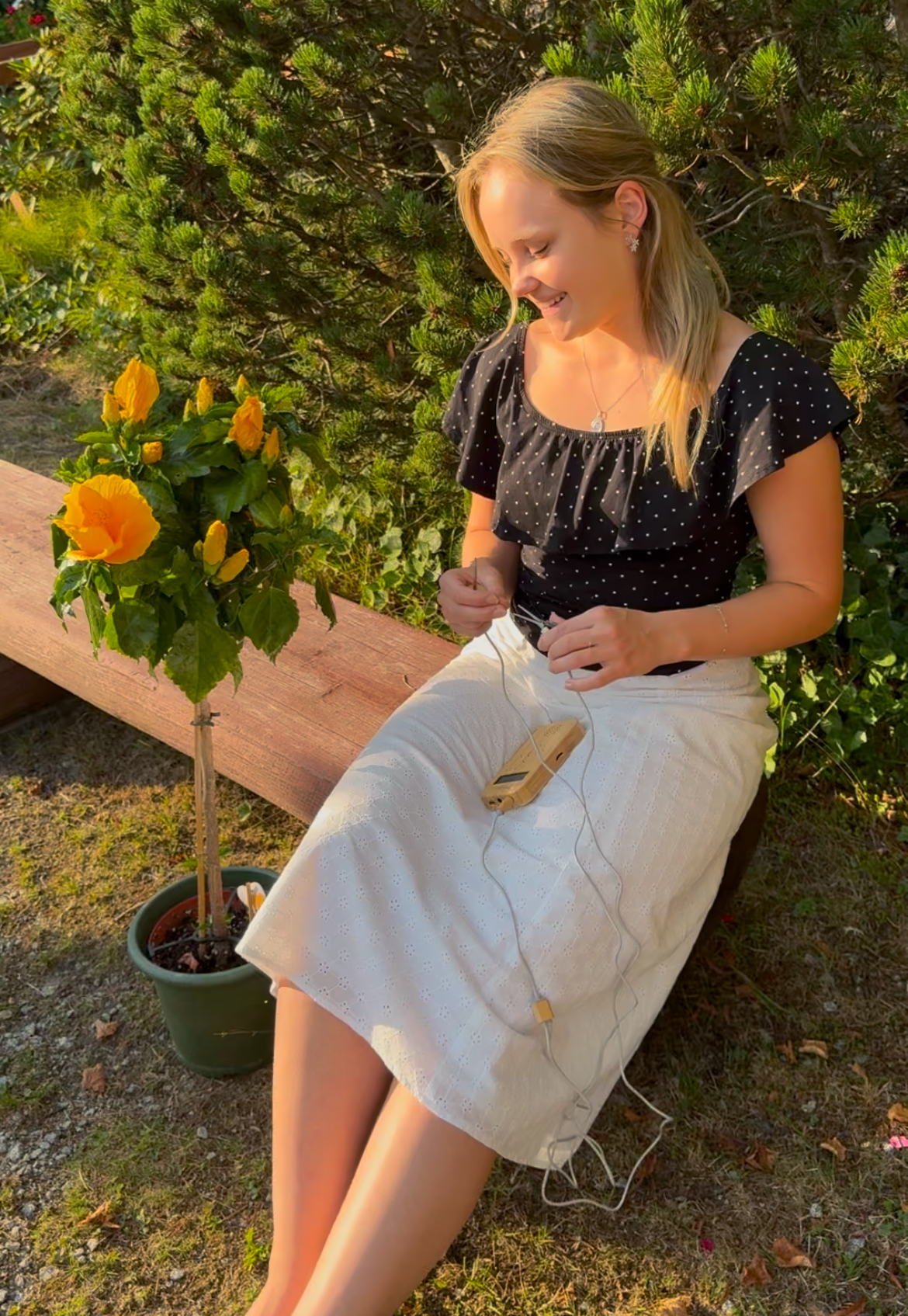
Electrical signals in plants are a real and long-studied natural phenomenon. Plants respond to light, temperature, touch, water and other stimuli through changes in their electrical potentials. The music you hear is therefore not the literal “voice” of a plant, but a poetic sonic translation of these subtle biological changes.
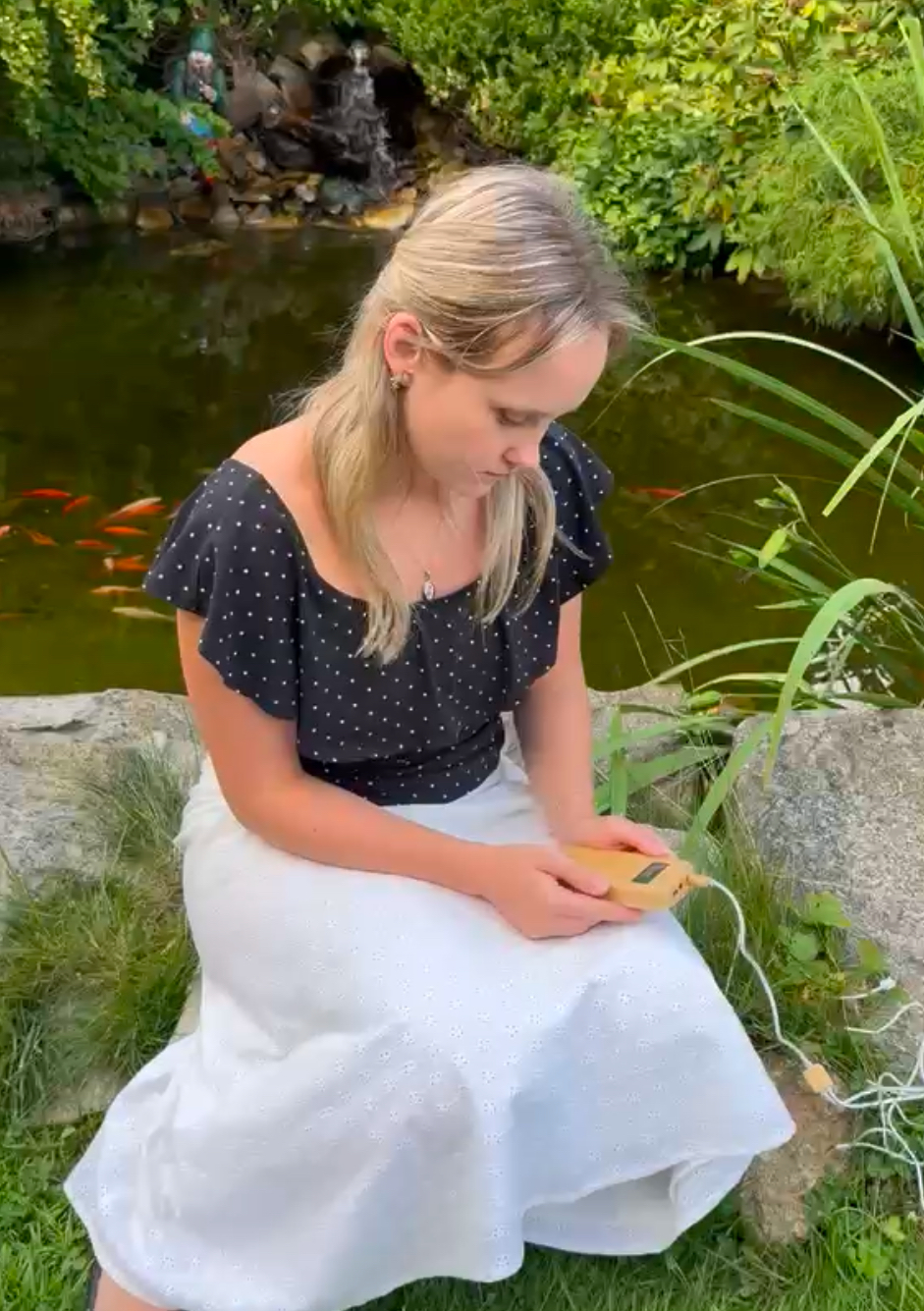
Think of this experience as an invitation to slow down, look around more attentively and discover the forest and garden from an unusual, musical perspective.
Borrow a device and connect with the plants

We will be happy to lend you one of the devices for a walk through the surrounding forests. Take it with you to a flower, a tree leaf or a shrub and discover nature with new ears. It is a wonderful addition to a peaceful walk, a moment to pause and a shared experience with children.

We will be happy to advise you on choosing the right device and show you how to use it. Please handle it with care so that neither the plants nor the surrounding nature are harmed, and so that we can continue lending the device to other interested guests.
Music of the Plants on your walk
We are happy to lend you the Music of the Plants device at our hotel for 10 EUR.
The symbolic rental fee will be used to purchase additional devices, so that as many of our guests as possible can enjoy this unique experience.
Music of the Plants in Your Home
Would you like to have your own device at home or give one to someone as an original gift? You can order it directly from the manufacturer.
ORDER ON PLANTMUSIC.COMWe believe that plants are conscious living beings with a highly developed collective intelligence
When we begin to look at plants as active, conscious beings, we become more aware of their subtle behaviours and strategies. Root tips exhibit electrical activity that is very similar to our „brain“. Many scientists have found that plants are not only capable of „sensing“ chemicals and „seeing“ light emitted by surrounding plants, but may even be able to „hear sounds“ produced by themselves and by other plants. Since the 1970s, the Federation of Damanhur Communities in Italy has been researching communication with plants. This device decodes the electrical impulses of a plant and transforms them into music. Plants respond in highly sophisticated ways to both physical and intellectual stimuli. The electrical impulses of each organism are unique, and each plant therefore creates its own individual biological „sound signature“. We have also discovered that plants can communicate with humans. Once a plant becomes aware that the sounds produced by the Music of the Plants device are the result of its electrical activity, it learns to modulate its own energy and thereby change the sounds it produces. The more experience a plant gains with „playing music“, the better it becomes at modulating its sounds, communicating with humans and creating a genuine form of communication.
Welcome to the growing community dedicated to exploring the intelligence of the plant world!
How the devices work
Ginkgo
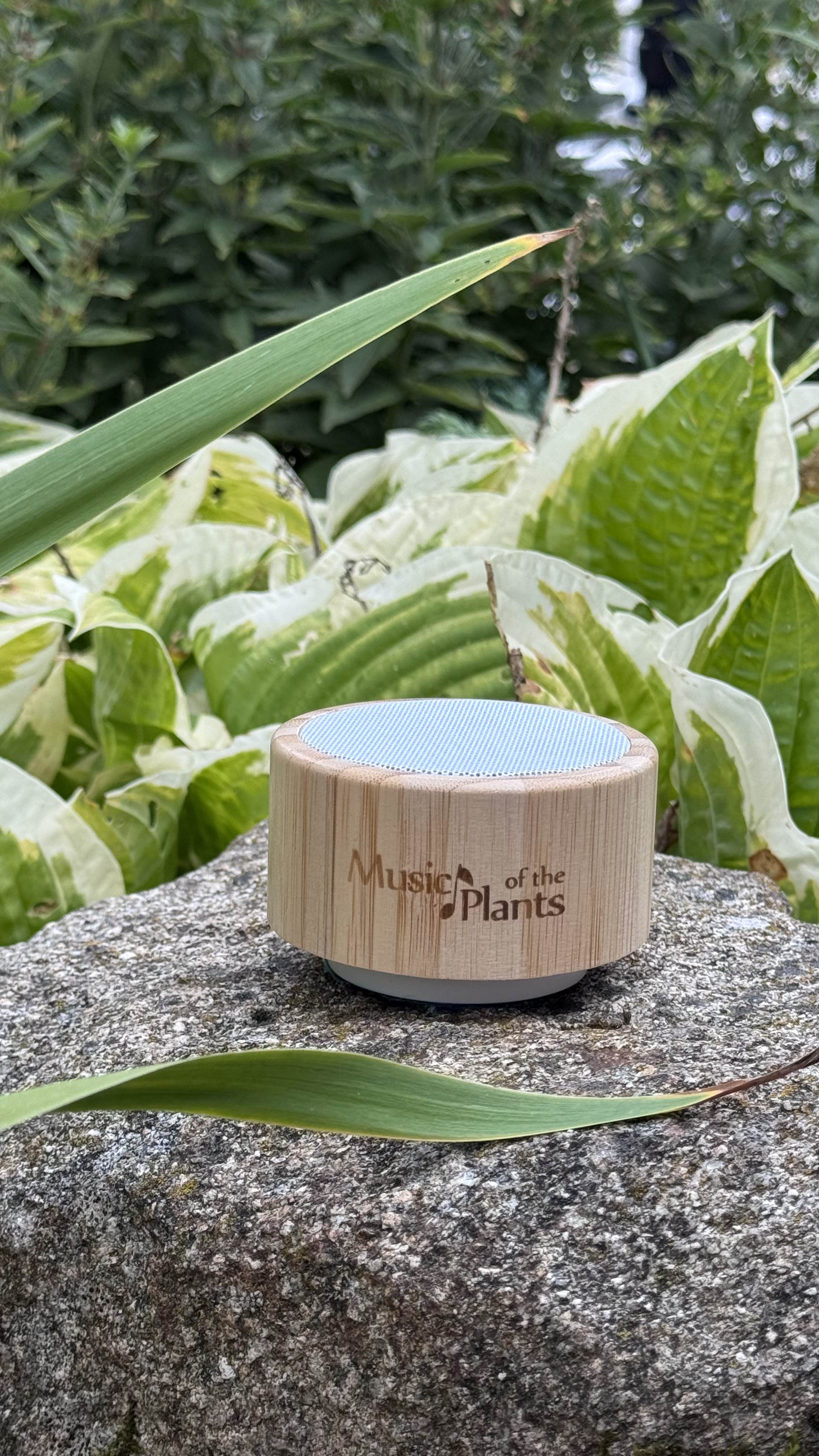
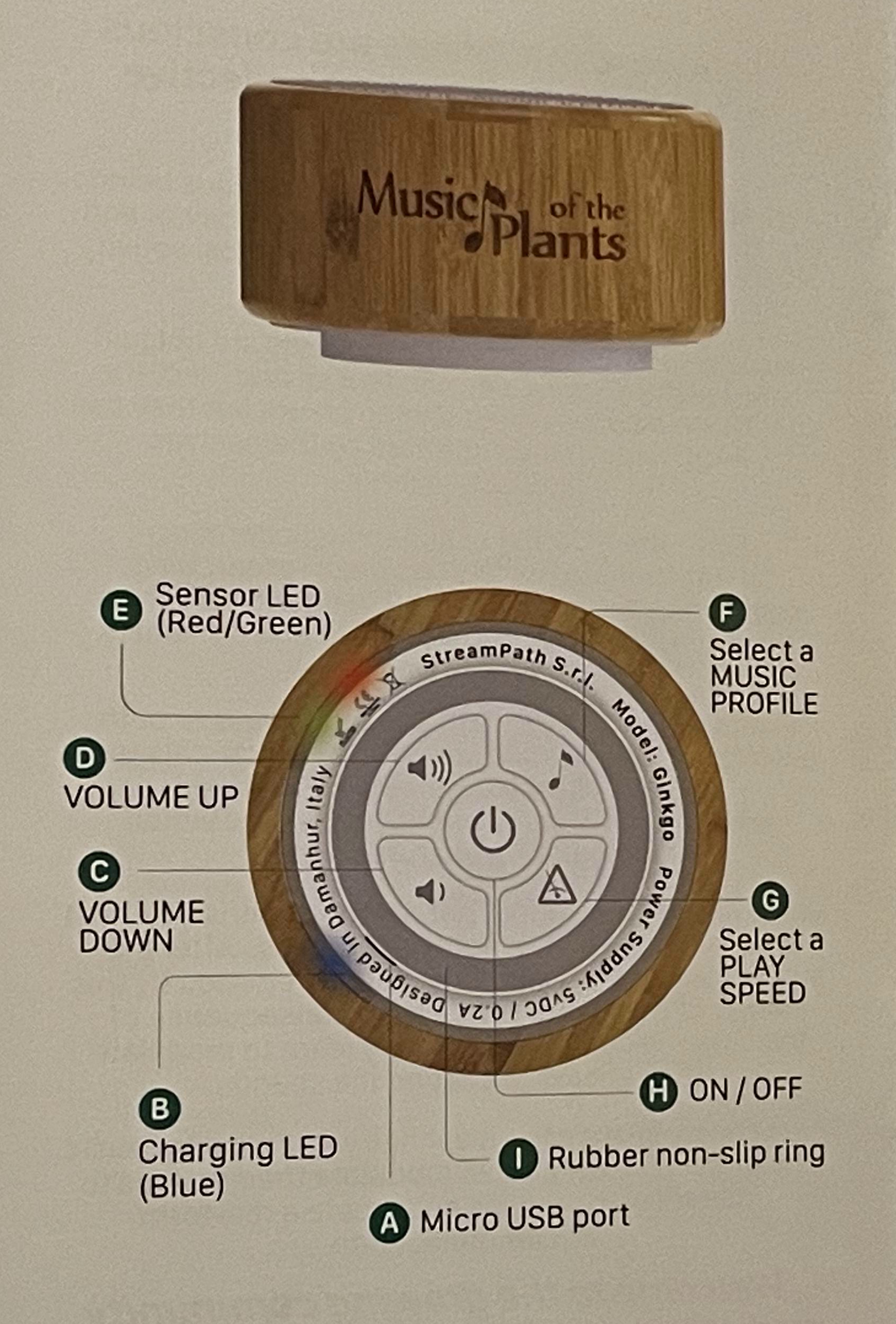
Ginkgo is a simple and beautifully portable device with a built-in speaker. It is switched on with the ON/OFF button; separate buttons allow you to adjust the volume, select a sound profile and set the playing speed. The indicator light glows green when the cable is connected and the device is receiving a signal from the plant. The red indicator means that the cable or signal is not yet connected; blue indicates charging.
The connection is simple and gentle on the plant. The sensor cable consists of two parts: a brass probe for the soil and a fine spring clip for the leaf.
A – Micro USB port
The sensor cable is connected to this port.
The cable has two functions:
- Charging the internal battery – connect a USB charging adapter.
- Plant INPUT – The sensor cable has a grounding probe that is inserted into the soil next to the base of the plant or tree. The alligator clip is attached to any leaf of the tree or plant.
B – Blue LED
Charging is in progress.
C – VOLUME DOWN button
Decreases the volume.
D – VOLUME UP button
Increases the volume.
E – Red/green LED
- Flashing red LED: The cable is not connected or no signal is coming from the plant.
- Green LED: The cable is connected and the device is receiving a signal from the plant.
F – Select a PROFILE – PROFILE SELECTION
By pressing this button, you can select one of 3 different music profiles.
PROFILE is a predefined set of sound parameters, such as a musical instrument, musical scale and base frequency, through which the data from the plant can be played.
G – Select a Play Speed – PLAYBACK SPEED SELECTION
You can set the maximum tempo at which you want the plant to play. You can adjust the music to suit your mood or activity.
H – ON / OFF button
Power on/off button.
Bamboo
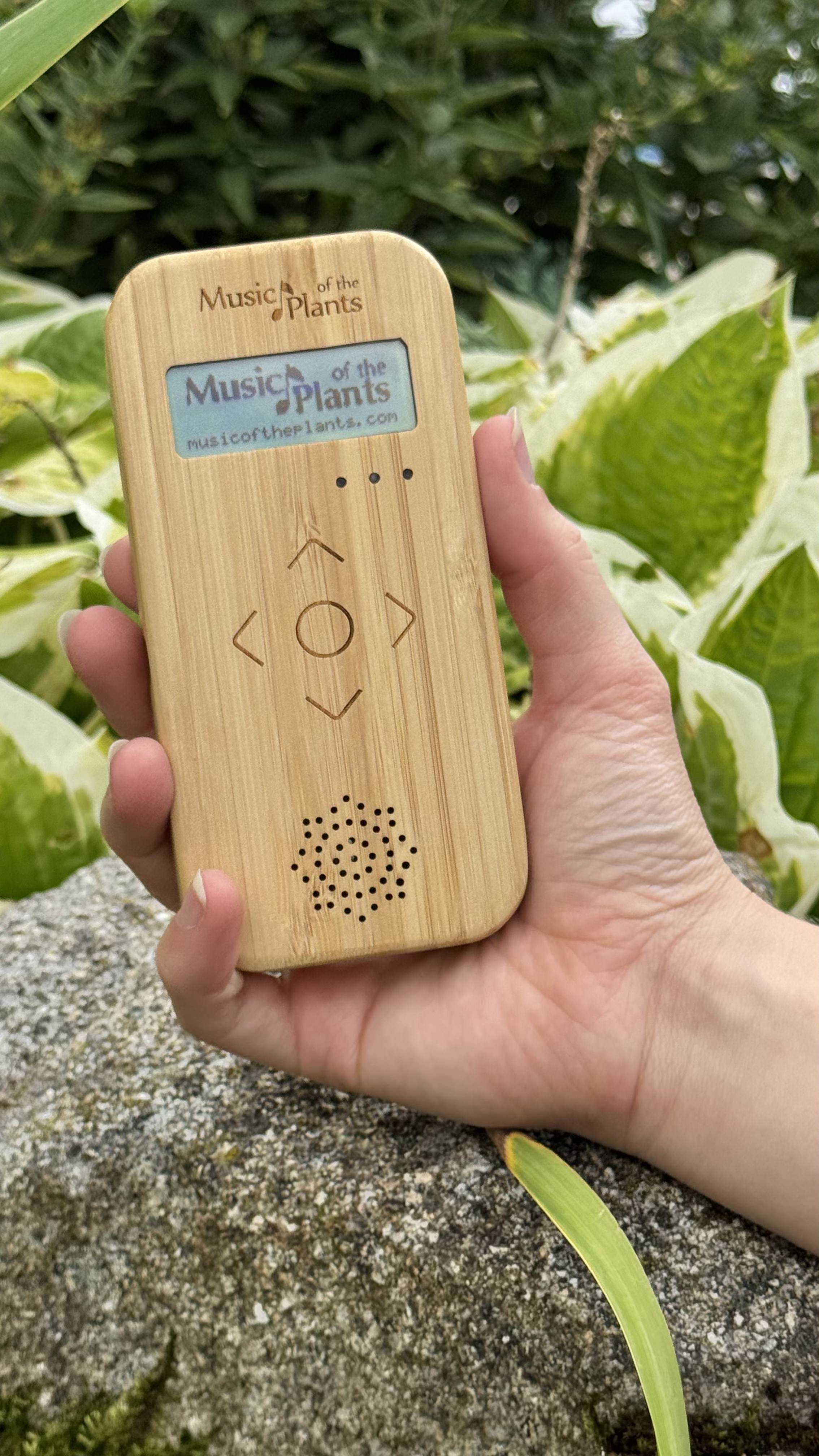
Bamboo offers more setting options and features a display. You switch it on using the ON/OFF switch. Use the arrow buttons to navigate through the menu and change selected values; the middle button takes you back one level. On the display, you can select the sound profile, volume, device sensitivity and tempo.
Bamboo also offers a wider range of music settings, allows you to work with the sound in greater detail and, depending on the equipment, connect headphones or save recordings. For a regular walk, Ginkgo is the simplest choice; Bamboo is ideal for guests who want to explore the sound and settings in greater detail.
<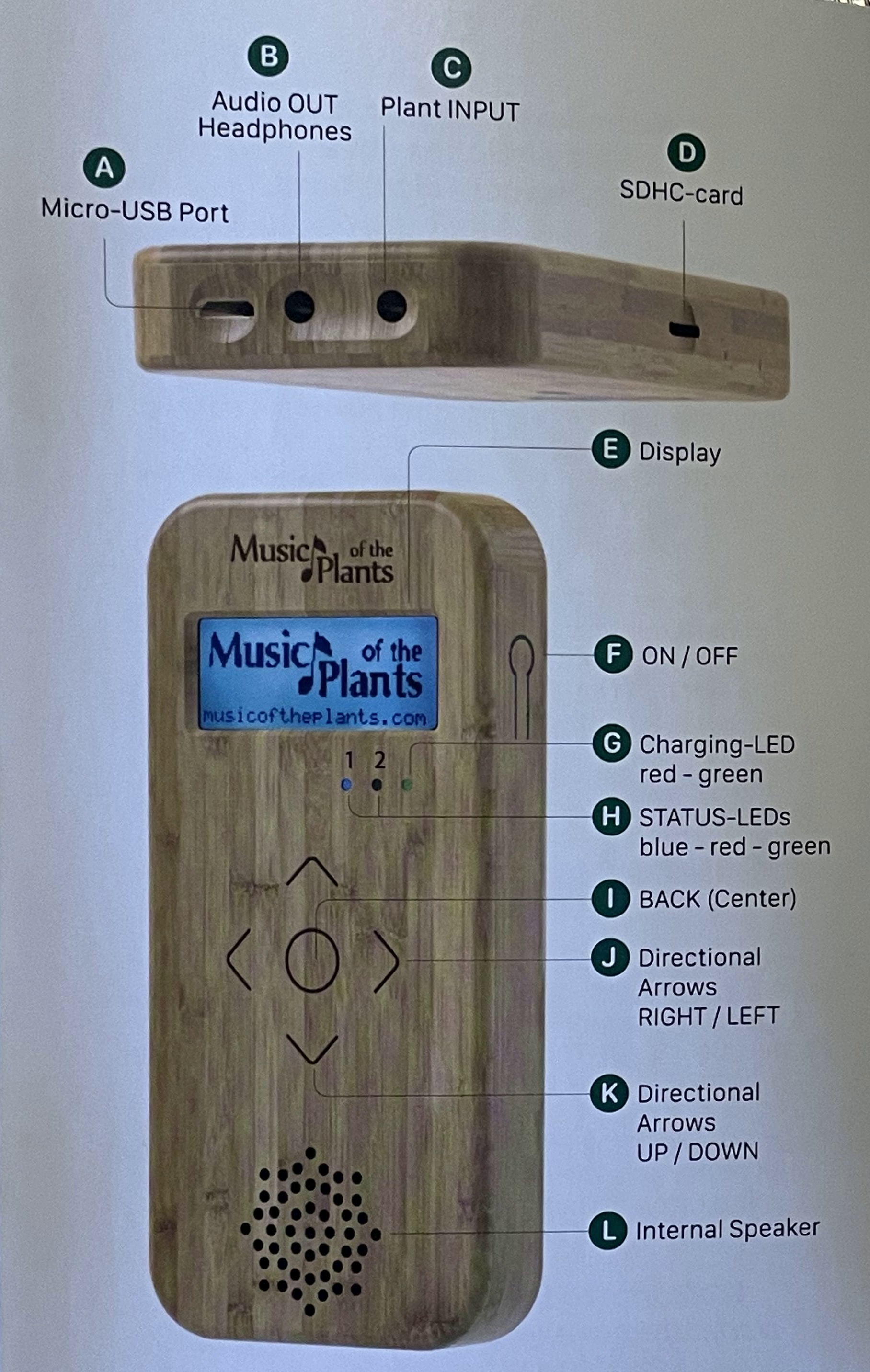
A – Micro-USB port
This port has three functions:
- Charging the internal battery – connect a USB charging adapter.
- MIDI output to a computer – connect the USB cable to the computer.
- Data output to PC (Windows only). Connect Bamboo to the computer using the supplied USB cable. The Bamboo Control software must be installed on the computer for this function.
B – Audio Out
This port has two functions:
-
Connecting an external speaker – when an external
speaker or headphones are connected, the internal speaker is disabled.
Music can be saved as an audio file on a smartphone using a special smartphone cable.
- MIDI output to a MIDI interface – using a special Micro-USB–5-pin DIN cable, Bamboo can be connected to a MIDI device, such as a synthesizer or mixing console.
C – Plant INPUT
3.5 mm stereo connector for the sensor cable, which connects the electrodes to the plant:
- Spring Clip – spring clip attached to the leaf
- Metal Probe – metal probe inserted into the soil
D – SDHC card
Allows data from the plant to be recorded onto an SDHC card.

I – BACK
- Pressing the centre between the four directional buttons takes you back one level in the menu at any time. J/K – Directional buttons
- UP – up → previous menu item
- DOWN – down → next menu item
- LEFT – left → lower value / selection on the left
- RIGHT – right → higher value / selection on the right
E – Display
Displays the menu and status information.
F – ON/OFF
Device power switch.
G – Charging LED
- red – charging in progress
- green – battery fully charged
H – Status LEDs
LED 1:
- flashing blue – sensor cable is not connected
- steady blue – cable is connected, but no signal is coming from the plant
LED 2:
- red – searching for the plant signal
- green – the device is playing music
When there is no music
If Bamboo M is not playing, check the following: 1. Music of the Plants is a technology that gives plants a „voice“. Just like people, plants sometimes do not want to „speak“. In such cases, their signal may fall below the audible level. A plant’s behaviour depends on many factors, such as ambient light, water availability, temperature, soil fertility, etc. Other factors that can influence a plant’s „music“ include its current state of health, flowering, leaf fall, and so on. Plants may also be influenced by human factors such as our thoughts, intentions, emotions and touch. 2. Begin each music session by moistening the leaf beneath the metal clip. In addition, pour a little water onto the soil above the roots where you insert the metal probe. Water helps improve the electrical conductivity between the plant and the device. 3. Plants with thick and glossy leaves, such as camellias, or with hard leaves, such as succulents or cacti, may interfere with the clear transmission of electrical signals. Choose plants with thin and soft leaves. Also make sure that the weight of the cable does not place too much strain on the branch. 4. Music created from clones, meaning genetically identical plants, is less consistent than music created from genetically unmodified plants of the same species. Likewise, wild-growing plants are reportedly said to produce better results than flowers purchased from a florist. 5. Tap water is chlorinated in many cities to kill bacteria and often contains traces of other chemicals that may negatively affect the health and vitality of the plant. If the plant is also in a small, restrictive plastic pot or there is too much activity in the room, this may stress the plant and lead to limited or no activity. 6. Our thoughts and feelings may also affect the plant’s activity level, as can our behaviour and attitude. If the plant does not respond, try sincerely expressing your desire to communicate with it.
We hope you take home not only wonderful memories, but also a new perspective on the world around us.